
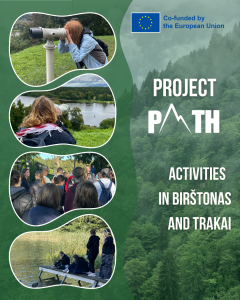
 National piloting activities of the PATH project in Lithuania brought together young people, volunteers, NGO representatives, and local partners to explore how hiking routes can support co-design, future planning, and non-formal learning. The two national pilots took place in Birštonas on E-path 11 (Miško takas) and in Trakai with local school youth, building a connected experience around participation, nature, and personal development.
Birštonas hike on E-path 11
The first activity was a hike along E-path 11, gathering volunteers, young people, and NGO representatives within the framework of the PATH project. Here, in addition to walking, strong co-design elements were introduced: participants were invited to actively shape parts of the activity, share ideas, and contribute to how future PATH-related actions could look. This collaborative approach was prioritised over individual reflection, turning the hike into a living laboratory for testing methods, listening to youth voices, and co-creating future directions for the project.
Trakai activity with local youth
The second activity continued the overall approach in Trakai, implemented together with the Trakai open youth space and a group from the local gymnasium. Local guides and youth workers led the group along a “youth trail”, offering young people the chance to act, experience, and participate meaningfully in a familiar environment. While less centred on co-design than the first hike, the Trakai activity still encouraged youth participation, dialogue, and connection to local nature and surroundings.
Shared results and added value
Across Birštonas and Trakai, the message was clear: in project implementation, participants and the opportunities they receive to act and experience are at the centre. The combination of co-design in Birštonas and youth-focused practice in Trakai showed how hiking and local trails can support youth empowerment, experimentation with methods, and community connection. The activities were facilitated with the support of an experienced hike leader and realised with funding from the European Union, demonstrating how European cooperation can strengthen local youth work and outdoor education.
Financed by European Union.